
Concepts (experimental)
Forward-looking product concepts not yet on the committed roadmap. Ideas we're pressure-testing.
Radial gesture control — the app's primary interface
The idea: the main way you control the home isn't a wall of toggles — it's a **radial
gesture**. Press the center of the screen, flick toward a direction (every 45° — cardinals
and diagonals), release to trigger. One thumb, eyes-half-closed, muscle memory. Flick
up-left for Goodnight, right for Cameras, down for Lock.
This is a marking menu (a.k.a. radial/pie menu): touch → swipe → release. The research
is clear on why it works — the menu teaches novices, but experts recall the angle and flick
blind, faster than visual memory; and a drawn trail lets you correct mid-gesture.
Why it fits openhome:
- Speed. The most-used actions are one gesture away — no menu diving.
- Muscle memory. Directions become reflexes; you stop looking at the screen.
- Accessibility & one-handed. Big targets, no precise tapping, works blind.
Design decisions (from the marking-menu literature):
- Hidden until pressed. At rest it's just the orb — icons fade in only when you press, so
the screen stays calm and expert flicks feel instant.
- Drawn trail. A mint line follows your finger through the wedges so an off-course gesture
is easy to fix before you release.
- Directional chords → scenes. Chain directions for compound actions. Live today:
- ↑ → ↗ = 🌙 Nighttime (lights off, doors lock, music off)
- ↑ → ↓ = ☀️ Good morning (lights on, unlock, coffee, music)
- ↓ → ↑ = 🛏️ Matthew's Room (bedroom light + speaker + shades)
- ↗ → ↘ = 🎉 Party (every light full, music up, shades open)
- ← → → = 📖 Reading (soft office + living light, quiet elsewhere)
This is a multi-stroke marking menu — 8 directions become a deep, fast tree without more screen.
Live prototype: try it at /control — hold the center, flick to act, or chain
directions for a scene. Each trigger toggles real device state (watch the chips + the
dashboard Devices card update live) and posts a control.* event.
Open question: action + chord mappings should be user-customizable, with smart defaults per home.
openhome Pod — ambient mesh in every outlet
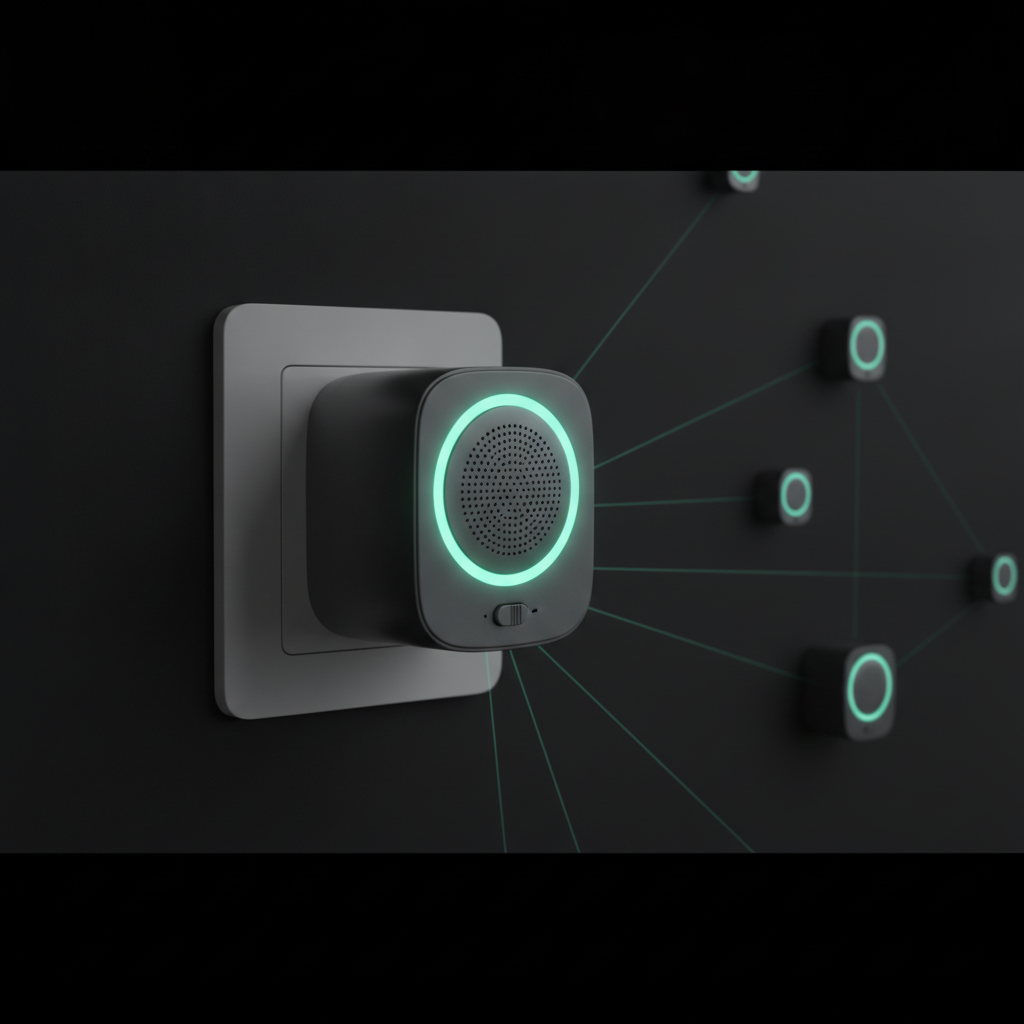
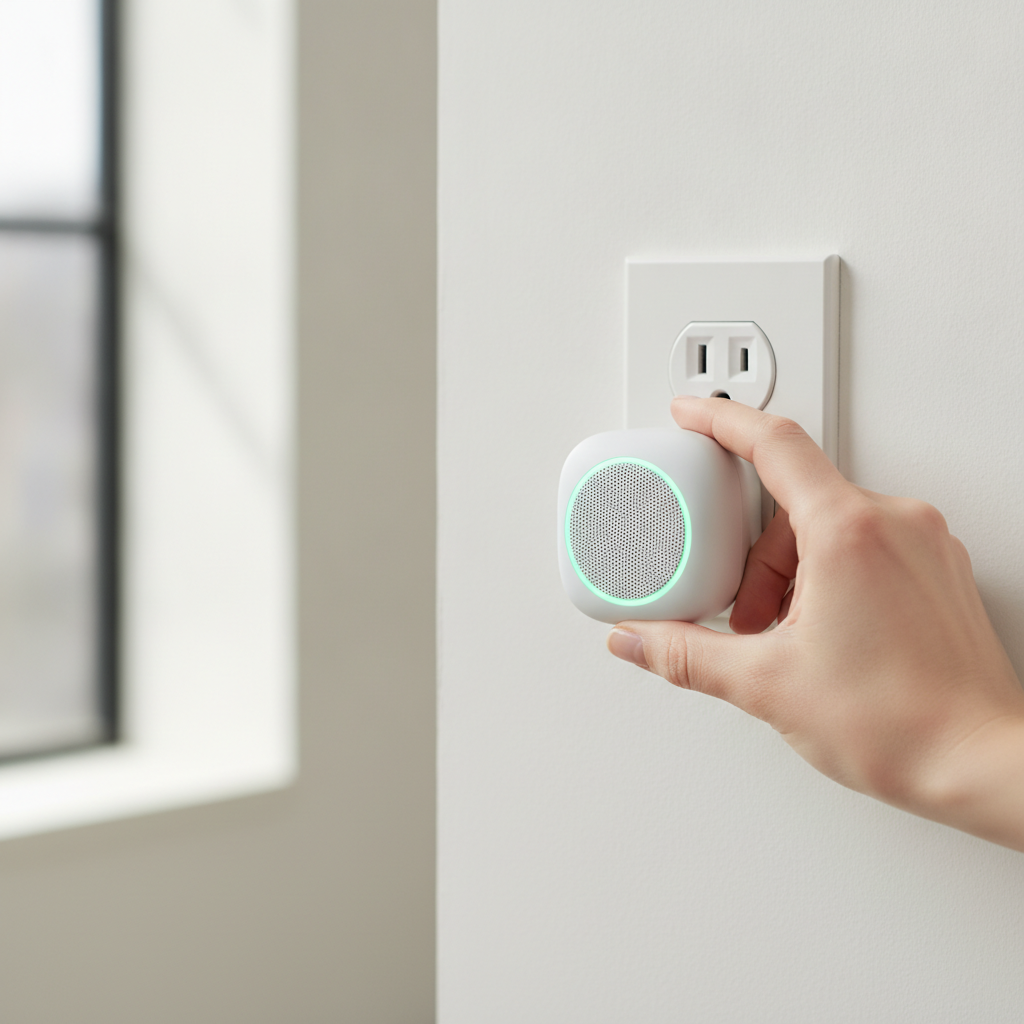
The idea (credit: a friend of Matthew's): take a wall charger, add a microphone and a
small compute module, and let the openhome agent live in the outlet. Drop a few around
the house and they form a mesh — whole-home coverage, no single point of failure.
Why this is strong
The single-box design has one weakness: it's one box, in one spot. Pods fix that and add a
whole product line:
- Distributed senses. A mic + sensors in every room gives the agent real presence —
voice control anywhere, plus acoustic events (smoke-alarm chirp, glass break, a knock,
running water) without cameras.
- Mesh resilience. Each pod is a **Thread border router + WiFi mesh node + Matter
controller**. Coverage scales with the number of pods; no dead zones; the home keeps
working if one dies.
- Edge compute at the edge. Wake-word and simple inference run on the pod; the box (or
cloud, opt-in) handles the heavy reasoning. Latency drops, privacy improves.
- Power is free real estate. It's already plugged in — no batteries, always on, and it
still charges your phone. The most frictionless install in the home.
- Business gold. Households buy several pods, not one hub. It multiplies device count,
strengthens the mesh, and creates a natural "start with one, fill the house" upgrade path.
The landmine — and why it becomes our moat
An always-listening mic in every room is **exactly the Alexa/Echo surveillance model our
brand exists to reject.** If we get this wrong, we're the thing we're fighting. If we get it
right, it's the most convincing proof of the whole thesis.
Non-negotiable privacy design:
- On-device wake word. Audio is processed locally; nothing is recorded or streamed until
an explicit wake word. Raw audio never leaves the home — ever, by architecture.
- Hardware mute. A real physical switch that cuts mic power (not a software toggle), with
a mint LED that is on when muted — you can see the mic is dead across the room.
- Visible listening state. A light that unambiguously shows when the mic is active.
- Local-only by default. Voice → intent → action all happen on your box. Cloud voice/LLM
is a per-pod opt-in, off out of the box.
- Auditable. Open firmware; anyone can verify the mic behaves as claimed. That's the
difference no closed vendor can offer.
Positioning: *"Alexa listens for Amazon. openhome listens for you — and you can prove it,
because you hold the key."* This is the Pod's entire pitch.
Open questions
- Compute vs. cost/heat/size in a plug form factor — how much inference fits, and at what BOM?
- Certification (UL/CE) for a mains-powered mic device — real but standard hardware work.
- Mic-only vs. mic + more (temp, humidity, presence radar, IR blaster?) — how much sensor to pack in.
- Regulatory — two-party consent / always-on-mic laws vary by region; on-device-only helps.
Where it lands
A Phase 2–3 hardware concept and a flagship first-party device: the openhome Pod
(and a Pod Mini without the mic, purely as a mesh/Thread extender for the privacy-averse).
It slots into the catalog beside the box as the thing that turns one hub into a whole-home
nervous system.